
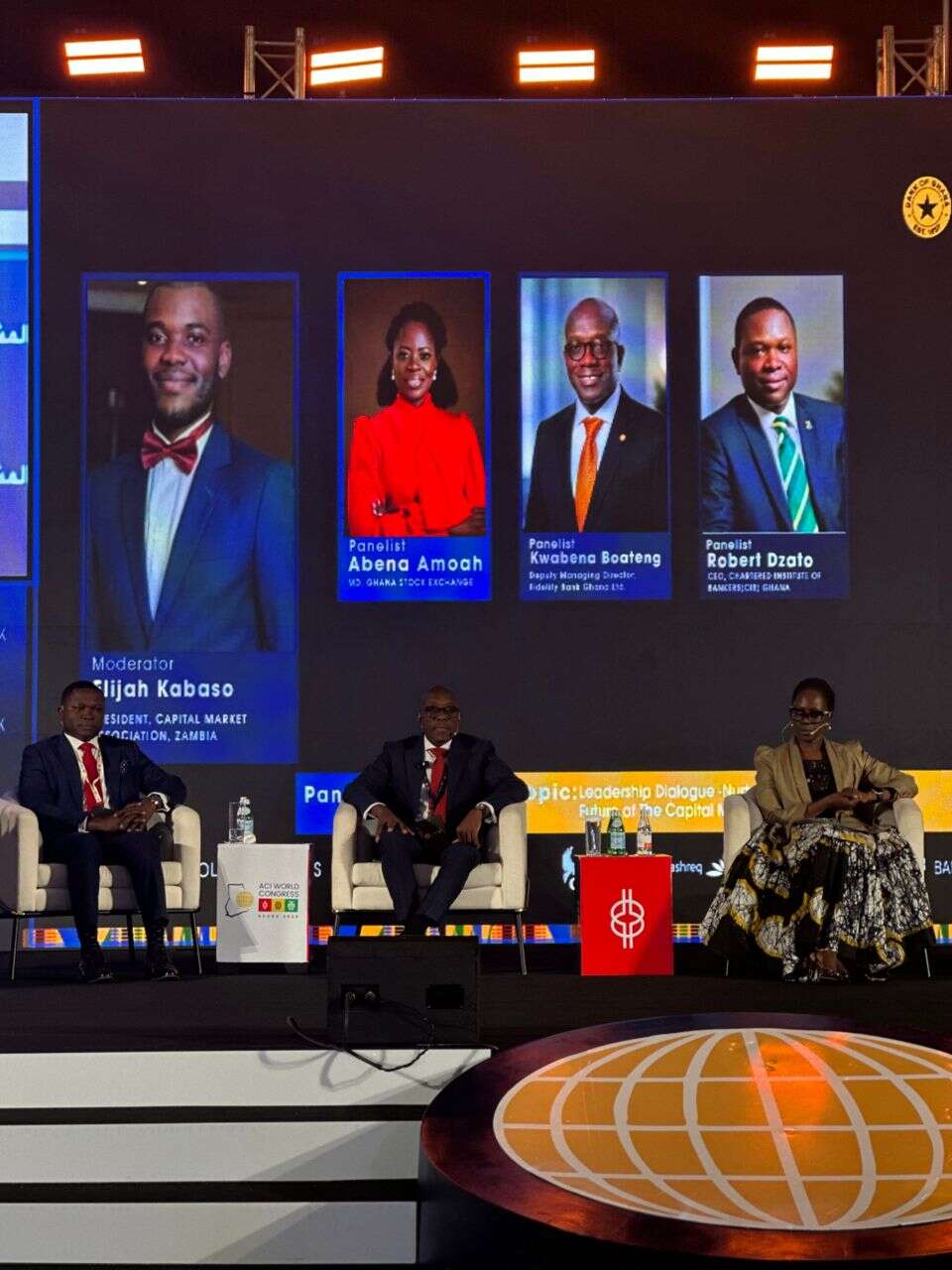

Kwabena Boateng, Deputy Managing Director for Wholesale Banking at Fidelity Bank Ghana, has called on institutions across the financial services industry to treat leadership development as a boardroom priority rather than an HR function, arguing that the future of capital markets depends on how deliberately organizations identify, nurture, and invest in their next generation of talent today.
Mr. Boateng made the remarks as a panelist at the Leadership Dialogue: Nurturing the Future of Capital Markets, held at the ACI World Congress in Accra. Speaking from Fidelity Bank’s own experience building internal talent pipelines, he offered a practical and candid perspective on what genuine leadership development looks like when an institution takes it seriously.
His central argument was that identifying future leaders is work that must begin early, and it must be structured. “If you do not do the right sourcing, putting them through the needed training, you will not get what you want,” he said. “It should come from the top. It should come from the boardroom. We should all be invited and ensure that these young people are trained and we extract the best out of them.”
Mr. Boateng outlined Fidelity Bank’s two-pronged approach to developing talent from within. The first is the Orange Talent Programme, designed for high-potential employees already in the organisation who undergo rigorous selection and cross-functional training across different business units.
The second is the Graduate Training Programme, which brings in fresh university graduates at entry level and builds their capabilities from the ground up.
Both programmes, he explained, are built around structured mentorship deliberately designed so that a mentee’s direct line manager is not their mentor, ensuring the relationship remains developmental rather than hierarchical.
He went further on what mentorship actually means in practice, pushing back on the common assumption that it is simply a transaction between an older and a younger person. “Mentorship is an experienced person sharing what they know; their thought processes, not only just the work, but also their daily life, their experiences, their failures,” he said.
He pointed to instances where professionals have been seconded to organizations in entirely different fields as a form of structured attachment, a model he described as producing some of the richest learning precisely because of how unfamiliar the environment is.
For Mr. Boateng, the deeper issue is diversity of thought within leadership pipelines and the danger of institutions that inadvertently replicate themselves. “If as managers or leaders we expect to have the same leadership pipeline thinking like us, then what we have done is form a replica of ourselves. And that is very dangerous,” he said. “The wisdom or knowledge does not rest in one vessel. It rests in numerous vessels. And when we come together with different opinions and we converge, it is to the wider good and development of the organization.”
He closed with a direct challenge to institutions on the question of investment. “Just as we are ready to deploy resources into anything, we should be ready to deploy resources into leadership development because it is very critical,” he said. “If we are not ready to invest in our people as an institution, then we are moving on and leaving something behind that will not grow from generation to generation.”
For Fidelity Bank, Mr. Boateng’s remarks at the ACI World Congress reflect a leadership culture the bank has been building deliberately; one where developing the next generation is not a programme on a calendar, but a commitment embedded in how the institution runs.