
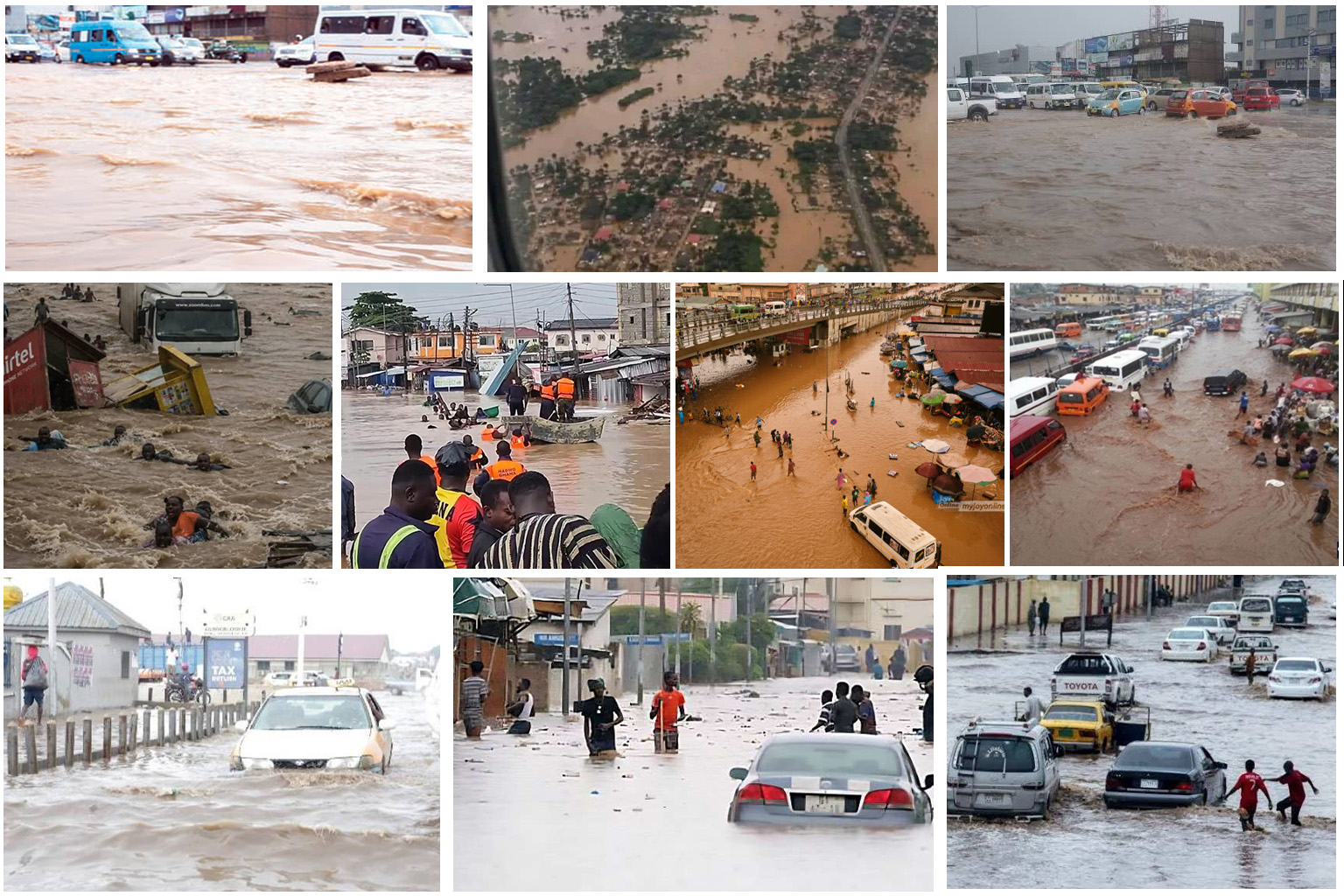

The recent floods that once again brought Accra to its knees are a painful reminder that our capital remains dangerously vulnerable. Lives have been disrupted, businesses devastated, homes destroyed and, tragically, families have lost loved ones. We mourn with those who have suffered.
Flooding is not a new challenge in Accra, nor did it begin with the Fourth Republic. For generations, parts of the city have experienced flooding due to its coastal location, low-lying terrain and seasonal rainfall patterns. However, what has changed is the scale, frequency and destructive impact of these floods.
Over the years, rapid population growth, uncontrolled urban expansion, increasing construction on natural drainage paths, loss of wetlands, poor waste management and the accumulation of weak planning decisions have significantly worsened the problem.
The crisis we face today is therefore not simply the result of heavy rainfall. It is the consequence of how we have planned, governed and developed our city over many decades.
President John Dramani Mahama’s decision to declare nationwide clean-up exercises is a welcome first step. However, Ghana must recognise that the challenge before us is far greater than removing debris after a flood. The real task is to confront the decades of planning failures, weak enforcement, institutional weaknesses and poor urban management that have left Accra exposed.
The floods should not be viewed simply as a natural disaster. They are also a reflection of how we have managed our city and protected the public interest over time.
Accra’s flooding crisis is the cumulative consequence of several factors: inadequate drainage infrastructure, unregulated urban expansion, poor waste management, environmental degradation, construction on waterways, weak enforcement of planning regulations and the failure of institutions to consistently protect the public interest.
The question before Ghana is not whether the problem is caused by engineering, human behaviour or poor planning. The reality is that it is all of these. Engineering solutions are necessary, but infrastructure alone cannot solve a crisis created by weak governance, poor enforcement and a lack of collective discipline.
This challenge was not created by one administration. It is the result of accumulated decisions, missed opportunities and institutional weaknesses under successive governments of the Fourth Republic. Every government has inherited aspects of the problem, announced initiatives, commissioned studies and promised solutions. Yet, after every major flood, we often return to the same cycle of emergency response, public concern and eventual inaction.
The difficult questions must therefore be asked.
Why have we failed to solve a problem that has confronted every government of the Fourth Republic? Why do we repeatedly establish committees, produce reports and make recommendations, only for the same challenges to persist? Why have previous interventions failed to deliver the transformation that Accra urgently requires?
The answer is not that Ghana lacks expertise. We have some of the finest engineers, planners, architects and development professionals. The challenge has been the absence of sustained political will, consistent enforcement, institutional accountability and the courage to make difficult decisions when powerful interests are affected.
However, accountability must extend beyond central government.
A serious national conversation must also examine the role of Metropolitan, Municipal and District Assemblies, traditional authorities, landowners, developers and regulatory institutions such as the Environmental Protection Agency (EPA).
Why have some assemblies approved or tolerated developments in areas that compromise drainage systems and public safety? Why have some traditional authorities and landowners released lands without sufficient regard for wetlands, waterways and environmental consequences? Why have regulatory bodies responsible for protecting the environment and enforcing standards struggled to prevent these practices?
The issue is not simply a shortage of laws. Ghana has planning regulations and environmental protections. The deeper problem is enforcement. Too often, political influence, economic interests and social pressure have overridden the long-term interests of society.
Great cities are not built by infrastructure alone. They are built through vision, discipline, effective institutions and leaders who are prepared to make decisions that may be difficult today but beneficial for generations tomorrow.
The current crisis presents Ghana with a historic opportunity. Accra must move beyond temporary responses and embrace a comprehensive urban renewal agenda that transforms the city into the modern, resilient African capital it has the potential to become.
The objective should not merely be to clean Accra after floods. It should be to rebuild Accra in a way that prevents future disasters.
This requires a long-term National Urban Renewal Programme for Accra that transcends political cycles and focuses on:
- modern drainage and flood-control infrastructure;
- strict enforcement of planning and building regulations;
- protection of wetlands, waterways and natural drainage systems;
- improved waste management;
- stronger local government institutions; and
- where necessary, the humane relocation of settlements that have encroached on critical water channels.
Accra cannot continue to be held hostage by illegal structures on waterways, irresponsible development, poor construction practices, weak enforcement and institutions that fail to act in the public interest.
Where structures threaten public safety, difficult decisions must be taken. Where officials fail in their responsibilities, accountability must follow. Where contractors deliver poor-quality work, consequences must apply.
Leadership is not only about responding to crises. It is about preventing them.
The challenge is not that Ghana lacks plans. We have produced numerous reports, strategies and recommendations over the years. The challenge is implementation—ensuring that decisions are followed through regardless of whose interests are affected.
Around the world, cities have been transformed because leaders chose courage over convenience.
Singapore did not become one of the world’s most liveable cities by accident. It invested in long-term planning, strict enforcement and institutional discipline. Kigali has demonstrated what consistent urban management and civic responsibility can achieve in Africa. Seoul’s restoration of the Cheonggyecheon River showed that bold decisions can transform cities for future generations.
These examples remind us that successful cities are built through choices made today.
Accra deserves the same ambition.
But government alone cannot create the city we want. Citizens also have responsibilities. We cannot demand a world-class capital while dumping waste into drains, building on waterways or defending illegal developments because they benefit friends, relatives or political allies.
A resilient Accra requires a new social contract between government and citizens—one built on responsibility, accountability and respect for the rule of law.
Climate change will undoubtedly increase the frequency of extreme weather events. But the scale of destruction we continue to witness is also linked to choices we have made: ignoring planning regulations, allowing uncontrolled development and failing to protect natural drainage systems.
Future generations will not judge us by the number of clean-up exercises we organised after floods. They will judge whether we used moments of crisis to create lasting change.
President Mahama and his administration have an opportunity to help lead that transformation. Success should not be measured only by the streets cleared after a disaster, but by whether Ghana finally develops the discipline, institutions and vision required to build a safer and more modern Accra.
The Accra floods should not become another chapter in a history of repeated failures. They should become the moment when Ghana finally decided to build the city its people deserve.
History will remember the choices we make.
Amb. Edward Boateng
Former Director-General, SiGA & Ghana Ambassador to China (2017–2020)