
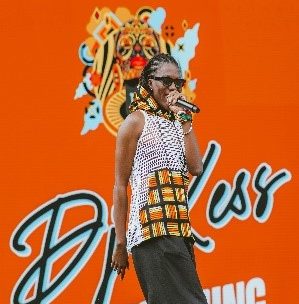

Princess AJ is loud on stage, shy off it, and living proof that a job most Ghanaians can’t even name is still, stubbornly, a man’s world.
Picture the scene. Somewhere in North America, a stage is buzzing with flags from every continent. Nationalities are colliding, the football is the excuse and the party is the point, and a Ghanaian woman steps up to the microphone to run the whole show. That is Princess AJ’s World Cup story.
“I played it cool at first, but I was definitely doing cartwheels and jumping jacks within,” she says. “It took a minute or so for it to sink in just how huge the opportunity was. It takes one person to mention your name in rooms, and our programmes manager, Erskine, came in clutch with the assist.”
“Meeting people of different nationalities in attendance for one of the greatest sporting activities in the world was such a surreal moment for me,” she says. “To represent Ghana, oh boy. I was beaming with pride. That was the cherry on top for me.”
Ask most people in Ghana what a hypewoman does and you will get a shrug, or a confused mash-up with an MC, a DJ or a vibes girl on Instagram. A hypewoman does not announce the running order. She reads a crowd’s temperature in seconds, decides how to raise it, and holds an entire room’s energy in her hands, usually while every person in that room is quietly deciding whether a woman can actually do the job.
“It only hit me when I realised a lot of women were MCs and not hypewomen,” Princess AJ says. “Distinguishing the difference made me realise how unique I was, and I delved fully into it.”
The obsession started long before any of that, back in her teenage years, glued to the radio, captivated by Jessica Opare Saforo’s command of a room she could not even see. That was the moment radio stopped being background noise and became a calling.
Years later, that calling landed her the drive show on YFM, historically a man’s shift on Ghanaian radio. She did not walk in asking permission.
“I do not look at it from a gender perspective,” she says. “I accepted the role and made sure there was no doubt in my heart that I could do it. My energy and personality is what the show needed. A breath of fresh air.”
She is just as unbothered on stage, where the doubt is louder and standing right in front of her.
“Some audiences can be tough, especially when they’re used to seeing a man in that role,” she says. “The moment you step on stage, you can almost see it on their faces: who is she, let’s see what she can do. Suddenly the focus shifts. Instead of just enjoying the moment, they’re watching your every move. That has never really bothered me, it fuels me. I bring my full energy, win them over from the very first moment, and once the crowd is with me, everything else flows naturally.”
Ask if she has ever walked into a room and felt outright resistance, and she draws a sharper line than you would expect.
There is warmth behind the grit too. Before YFM, there was Uniiq FM, part of GBC, and a night she still counts among her proudest. She interviewed Prince Bright of Buk Bak fame, and after the show wrapped, he sent her producer, Laud Marvin, a voice note calling it one of the best interviews he had ever given, and prayed for her over the message.
“It affirmed my purpose,” she says.
There is a bigger picture behind her individual grit, too. Ghana officially defines youth as anyone between 15 and 35, which puts Princess AJ squarely inside the age bracket carrying the heaviest weight of the country’s jobs crisis. Youth unemployment in Ghana currently exceeds 13 percent, and young women consistently face higher joblessness than young men across most of the country.
Ghana’s creative industry, still informally organised and undercounted, is one of the few spaces absorbing that overflow, already linked to over 1.2 million jobs nationally according to the Ministry of Tourism, Culture and Creative Arts. Globally, the same sector is worth roughly two trillion dollars and supports 50 million jobs, about half of them held by women. Princess AJ is not chasing a niche hustle. She is standing inside one of the fastest-growing job markets for people her age, in a corner of it that Ghana has not yet learned to take seriously when a woman runs it.
She wants that to change, and she is specific about how.
“We are more than capable,” she says. “Hire us because we’re talented, skilled, and worth the opportunity, not simply to balance out a diversity gap.”
She names the women who cleared her path without hesitation: Jessica Opare Saforo, Miss Naa, Caroline Sampson and Valerie Danso, alongside Bozoma Saint John, whose boldness she admires from a distance. She is already thinking about the girls coming up behind her.
“I’d love to be in a position where I mentor young girls to seize every opportunity and maximise their potential,” she says. “I need that balance in this male-dominated space, ASAP.”
Ask her what success looks like, not next year but in the career she would be proud to call finished, and she skips straight past bookings and brand deals.
“Success, to me, is about breaking barriers, opening doors, and clearing the path for the next generation to take up the mantle,” she says. “It means making the journey a little easier for those who come after me, so they can dream bigger, go further, and achieve even more.”
Off stage, she is, by her own admission, nothing like the woman commanding a crowd of strangers into euphoria.
“Ironically, I’m shy,” she says.
And if there is a teenage girl somewhere in Ghana right now, big voice, commanding personality, being quietly told to turn the volume down, Princess AJ already has the answer ready, no notes, no hedging.
“Do not dim your light for anyone,” she says. “Be unapologetically you. Your tribe will find you. Authenticity is rare, and that’s your superpower.”
Ask her for one word to describe the hypeman space in Ghana right now and she does not soften it: underpaid. Ask her for one word to describe what happens the moment she picks up a microphone, and she does not hesitate either: euphoria.
Somewhere, on a stage built for someone else, a room full of strangers is about to find out which one wins.
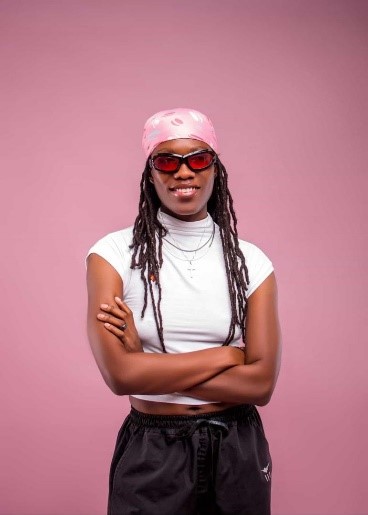
“It’s been more about fascination than resistance,” she says. “I’ve established myself well enough that when I’m booked for an event, it’s a no-brainer that I will deliver.”
That fascination is not a compliment Ghana hands out freely. A 2024 study by the Ghana Women Experts Project, carried out with the British Academy and City St George’s University, monitored six of Ghana’s biggest radio and TV stations and found women made up only 24 percent of on-air presenters, and just 14 percent of the experts invited onto flagship programmes.
Leadership tells the same story. Fewer than one in three leadership roles in Ghanaian media organisations belong to women, and only three out of twenty-five media companies surveyed nationally are headed by one. Ghanaian broadcaster Akua Sika has written about being passed over for prime slots because male managers treated the drive-time shift as “men’s territory”, regardless of her experience. Princess AJ walked into that same shift years later and simply did not entertain the premise.
Written by Bridget Mensah. Bridget believes the right story, told well, can change everything. A communications strategist and gender equality advocate with 10+ years in Ghana’s media industry, she uses words as tools for accountability and amplification particularly for women. She leads communications for the Network of Women in Broadcasting (NOWIB), She is the Head of Corporate Affairs at Ghana Digital Centres Ltd (GDCL)
[email protected]