
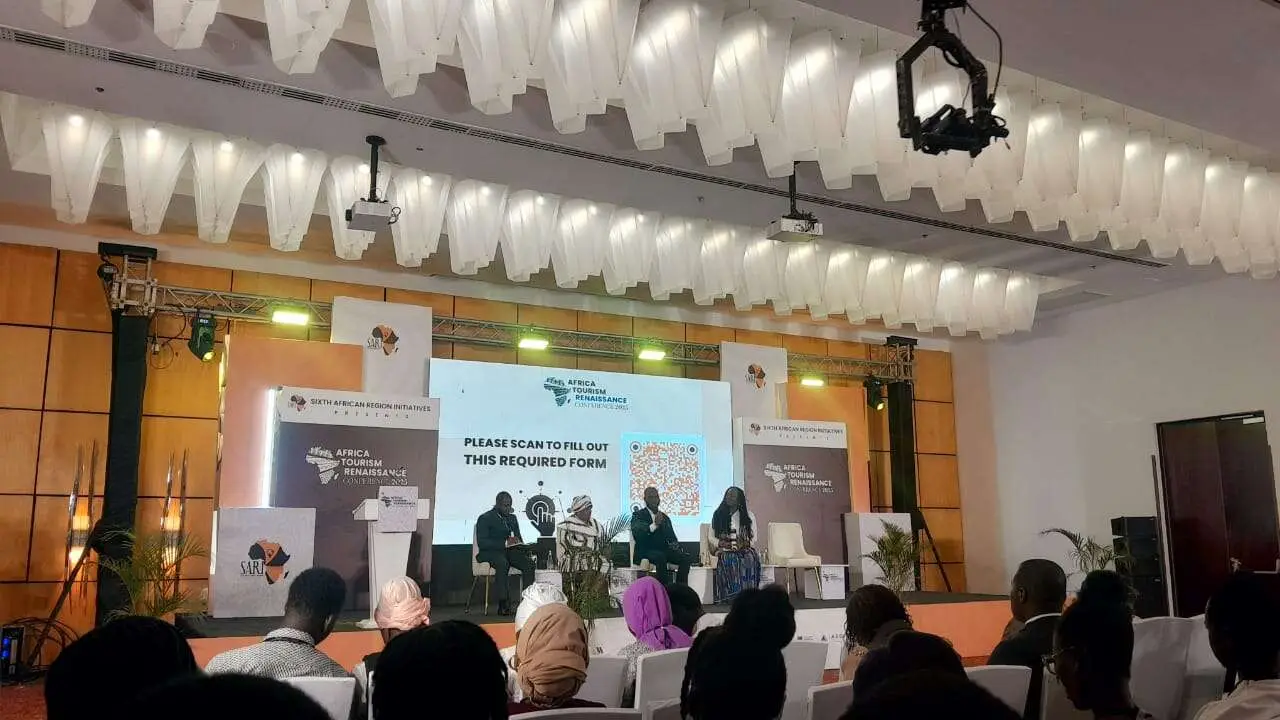
The Sixth African Region Initiatives (SARI) set the stage for intriguing discussions on tourism at the maiden edition of the Africa Tourism Renaissance Conference, held at the Marriott Hotel in Accra.
The event brought together industry experts from across the African continent and the diaspora to deliberate and exchange ideas. Founder of SARI, Zainab Muntari, explained that the conference seeks to ignite solution-driven conversations on economic justice, women’s empowerment, and youth development in Africa and Ghana at large.
“I’ve had over five years of experience in the industry. I did not just start. I started as a tour guide, then a tour operator, but even with that, I was just going back and forth. The most important thing for me was the experience. Experience led me to build SARI, and it’s one of the reasons we are here today,” she said.
Muntari further noted that the conference spotlighted opportunities for youth in the tourism sector, positioning tourism not just as an experience but also as a catalyst for development and economic stability. “I think Gastronomy, or what we term Culinary Tourism, Sustainable Tourism—and sustainable tourism falls in line with Agri-tourism—Tourism Infusion, Sanitation, and Wellness Tourism. I think these are some of the crucial things that we have to discuss, and our panel discussions have been fused with all these to make it possible for us to tap into them,” she explained.
Chief Executive Officer of the Ghana Tourism Development Company, Professor Kobby Mensah, delivered a keynote speech highlighting the sector’s contribution to development and economic stability. He urged young people to “get up and act,” pointing to the CRO of SARI as a role model for this call.
Keynote speaker and panelist, Dr. Toni Yvonne Luck from the Diaspora Africa Forum, in an exclusive engagement with YFM, emphasized Africa’s vast potential. She stressed that Africa’s opportunities have often been overshadowed by false narratives projected to the outside world.
She further lamented that the continent has been affected by a “mental plague” that muffles the true African identity and hinders collective development. “We had a stand, it’s called UBUNTU – I exist because you exist. But we’ve learnt Western culture, and the Western mind is about me. The African family does not think that way,” she said.
Aside panel discussions, the two day event which was held between September 25th and 26th, featured networking sessions and interactive discussion between patrons to bring out individual perceptions on specific country potentials and provide a holistic overview for audiences om the tourism industry.
The Africa Tourism Renaissance Conference an impact-driven which showcased panel discussions, workshops, compelling speeches and conversations on tourism on the African continent, its intersectional offsets in other industries.