
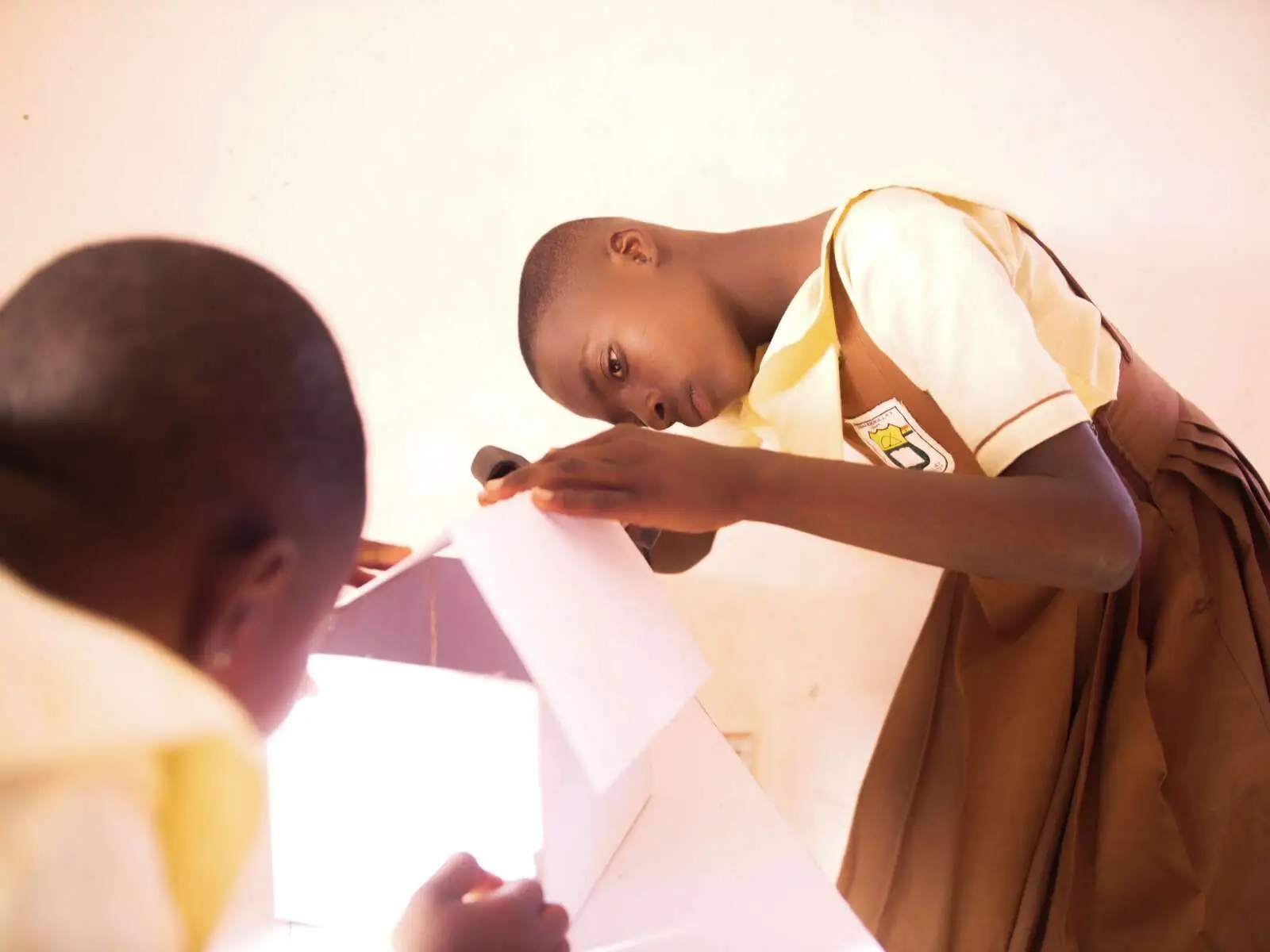
With a few days to the final exhibition of student innovations as part of the Telecel Foundation’s DigiTech Academy across five regions, a team of students in Jirapa is putting finishing touches to a robot designed to help detect and fight bushfires in farming communities.
The third cohort of the Telecel Foundation’s DigiTech Academy, made up of 500 students from 19 schools with 70 per cent female participation, is now at the final project stage. In the coming days, students across five regions will present completed robotics, coding, and digital solutions during graduation ceremonies in their respective communities.
At the Commission Information Centre in Jirapa, one of two digital labs hosting the after-school programme in the Upper West municipality, 12-year-old Miltiades and her teammates are refining their final project ahead of graduation: a bushfire-fighting robot built to respond quickly when fires break out in vulnerable areas.
For Miltiades, a student at Ganaa Memorial Junior High School, the project is deeply personal. Nearly every dry season, bushfires sweep through farms on the outskirts of Jirapa, destroying crops and leaving many families counting losses. Her own family’s maize and shea farm have been affected several times. “With the robotics training Telecel Foundation is giving us, I want to build something useful,” Miltiades said. “

At first, robotics felt difficult. The components and tools were confusing. But when I understood how they work, it became a session I enjoy every week.” “At first, robotics felt difficult. The components and tools were confusing. But when I understood how they work, it became a session I enjoy every week.”
Their robot is intended to be stationed in fire-prone locations, where it can detect unusual heat or smoke, move toward the source of danger, and release water to contain the fire before it spreads. The team is also exploring how to integrate an alert system that sends signals directly to the fire service in Jirapa for rapid emergency response.
Across the digital lab, other student groups are equally focused as final presentations draw near. Some are assembling robotic systems for automatic irrigation, automated waste bins and grass-cutting devices, while others are developing digital platforms to support local commerce, including websites and e-commerce tools for promoting locally woven Fugu and Kente products.
As a way of strengthening the practical relevance of their bushfire solution, Miltiades’ team recently visited the local fire service station, where officers explained how fire alerts are received, the most common causes of bushfires in the municipality, and how response teams mobilise. The visit helped the students rethink how their robot could complement existing emergency systems rather than work in isolation.
Her father, Robert Dookure, a public health officer and farmer, says the idea reflects the reality many farming families face each year. He is encouraged that his daughter is already thinking beyond the classroom and applying technology to a challenge that affects their livelihood and many other families in the area. “I am excited that Miltiades is working with her colleagues to build a bushfire solution. I think it must be coupled with education. Sometimes the fires are started by cattle herdsmen and game hunters on our farms. Awareness and education are equally important,” Mr. Dookure added.
The DigiTech Academy is a 12-week practical learning programme in robotics, coding and website design delivered alongside the Ghana Education Service curriculum. The current cohort is being implemented in Peki in the Volta Region, Kormantse in the Central Region, Jirapa in the Upper West Region, Goaso in the Ahafo Region, and Bolgatanga in the Upper East Region. Since its launch in September 2024, the initiative has reached 2,300 students nationally.
Rita Agyeiwaa Rockson, Head of Foundation, Sustainability and External Communications at Telecel Ghana, said the projects emerging from this year’s cohort demonstrate how digital education can help young people solve immediate community challenges. “It’s inspiring to see young people turn their challenge into purpose and build a solution for their community because that’s the true power of digital education.
Our aim with the Telecel DigiTech Academy is to nurture problem-solvers who are ready to transform and lead their communities with technology while closing the digital gap nationally.” Miltiades hopes to become a doctor one day, but says the programme is already teaching her how to identify problems, test ideas, and work with others to find solutions.
“If this solution is adopted and used, I think farmers will have bigger farms and yields. I am excited to be part of the Telecel DigiTech Academy to build something useful and relevant that solves my community’s problems.”
When graduation ceremonies begin at the end of March as the academic term ends, her team’s bushfire detection robot will be among the innovations unveiled, a student-built response to a problem that has affected farming communities in Jirapa for years.