
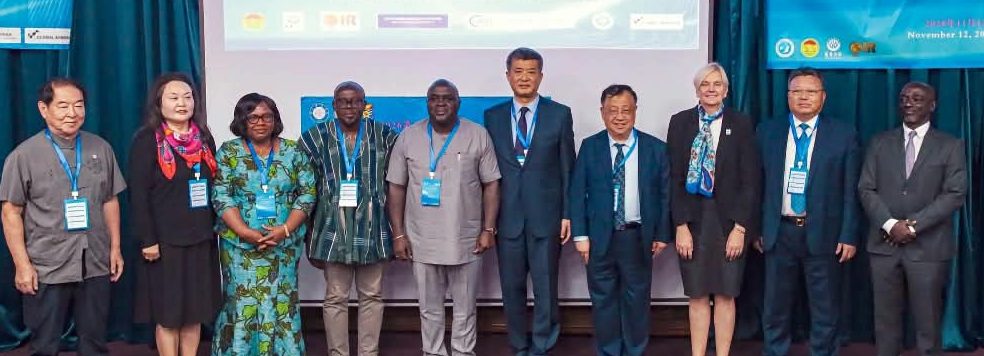

The 8th International Symposium on West African Studies (8th ISWAS) has opened at the Ghana Institute of Management and Public Administration (GIMPA) in Accra. Government, diplomatic and academic leaders used the opening to call for technology that makes governance work better for ordinary West Africans.
The symposium runs from 12th to 16th November 2026 on the theme “New Quality Productive Forces for West African Digital Governance Transformation and Sustainability”. It is hosted by GIMPA and the University of Cape Coast (UCC), in collaboration with the University of Electronic Science and Technology of China (UESTC).
The opening ceremony drew members of the diplomatic corps, representatives of the Chinese government, academics, development partners and participants joining online.
The Chief of Staff, Dr. Julius Debrah, who delivered greetings from President John Dramani Mahama, said the theme asks how advances in science and technology can help West Africa build more productive economies, improve governance and make those gains last.
He grounded the theme in the daily experience of a market trader renewing a business permit. “A morning spent in a queue to renew her business permit is a morning away from her customers,” he said. “Let her renew it from her store and you give her back the time she can spend earning a living.”
Dr. Debrah said the symposium’s focus fits the government’s economic agenda. “President Mahama’s vision for Ghana is an economy that produces more, adds value here at home and creates decent jobs,” he said, naming the Resetting Agenda, the 24-Hour Economy initiative and the Big Push Infrastructure Programme as the means of delivering it.
He invited Chinese investors to set up production in the country. “We welcome Chinese partners ready to manufacture in Ghana,” he said, and asked them to share technology and skills. He added that China’s zero-tariff treatment for Ghana and other eligible African countries opens “a new opportunity in a major market”, and credited Ghana’s mission in Beijing for its part in trade discussions dating back to 2019.
The Chinese Ambassador to Ghana, Cong Song, said the theme speaks to a challenge that developing countries share.
“Developing new quality productive forces is a common task for Global South countries and also a pivotal driving force in the latest technological revolution and industrial transformation,” he said.
The Ambassador congratulated GIMPA on its 65th anniversary and commended UESTC for its record in digital technology and big data. “UESTC has trained a lot of students from West Africa, demonstrating its strong commitment to talent development in Africa,” he said.
Noting that the forum has now run for eight consecutive editions, he hoped experts and scholars from China and West Africa would “pool wisdom and provide valuable insights” on the theme.
Professor Shurong Zhao, Director of the Center for West African Studies (CWAS) at UESTC which was founded in April 2017, through the platform of the Ministry of Education of China, with the collaborative support of partner universities, research institutes, and alumni in West Africa, set out the thinking behind the theme in her message to participants.
She said it “has been carefully selected to address the emerging opportunities and challenges associated with digital transformation, technological innovation, and sustainable development in West Africa”. The symposium, she added, will examine how digital technologies, artificial intelligence, big data and smart governance can support governance modernisation, regional integration and inclusive development.
“We hope that the 2026 ISWAS will generate new ideas, innovative approaches, and practical insights that can contribute to different societies while considering their diverse political, economic, cultural, and historical contexts,” Professor Zhao said.
She announced that the event will introduce a new book, Research on West Africa Development (Volume IV), to be published by China Social Sciences Press.