
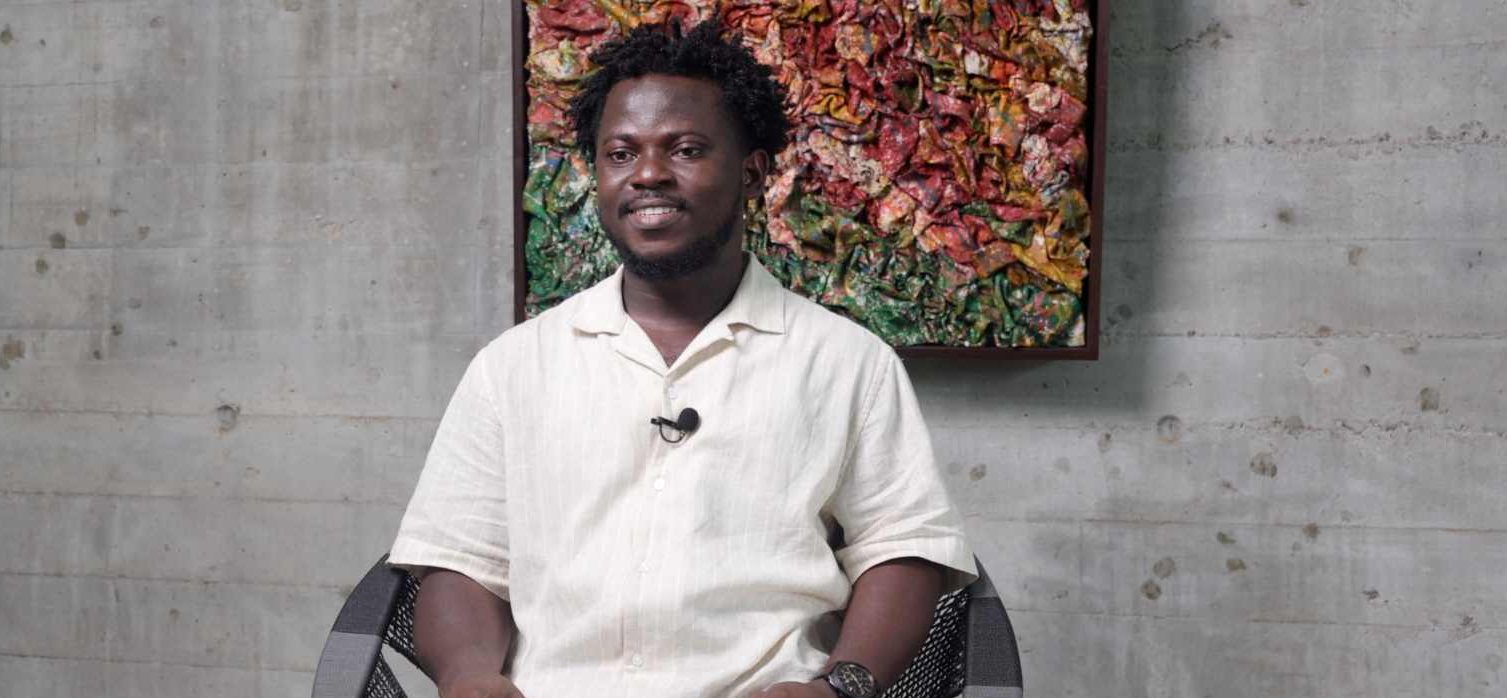

Ghanaian artist and civil engineer Emmanuel Aggrey Tieku, a winner of the Ellipse Prize, has built a decade-long artistic practice around transforming discarded clothing into large-scale installations, drawing inspiration from his childhood fascination with textiles and their connection to human life.
Tieku’s multidisciplinary practice explores themes of labour, memory, archiving, identity, consumption and sustainability. He sources second-hand clothing from Kantamanto Market, as well as discarded garments found on beaches and at landfill sites in Accra, transforming the materials into large-scale installations and studio-based artworks.
Speaking in an interview, Tieku traced his fascination with textiles to his grandmother’s collection of limited-edition prints from the 1950s and 1960s, which first sparked his appreciation for the material.
“It was through my grandma’s collection of limited edition prints from the 50s and 60s, and after that, my love for the material grew,” he said.
His interest deepened during his university studies when he worked on a project exploring the relationship between second-hand clothing and the construction industry. He said the project exposed him to the potential of repurposing discarded clothing and other materials for use in construction, drawing him further into the subject.
Over time, this interest developed into an artistic practice that uses discarded textiles to examine how people live, remember, identify themselves and relate to the world around them.
For Tieku, the enduring presence of textiles throughout human life is central to his connection with the material. He explained that clothing accompanies people through significant moments, from birth to death, carrying memories and stories along the way.
“The most important thing that connects me is its enduring scope of capturing the human essence, in a way that it meets us at birth and in a way that it sees us off when we die, and the stories that are strung in between these two very important parts of our lives,” he said.
Tieku also reflected on his first solo exhibition in Paris, describing the experience as significant to his artistic journey.
“It was quite the experience,” he said.
He explained that exhibiting his work in a different cultural setting helped him appreciate the diversity of people’s identities, perspectives and lived experiences. Although encountering unfamiliar cultural viewpoints could be challenging, he said the experience also created opportunities to meet new people and engage with different ways of seeing the world.
Through his use of discarded textiles, Tieku continues to explore the relationships between material, memory, identity and sustainability, demonstrating how clothing can carry stories that extend far beyond its original purpose.