
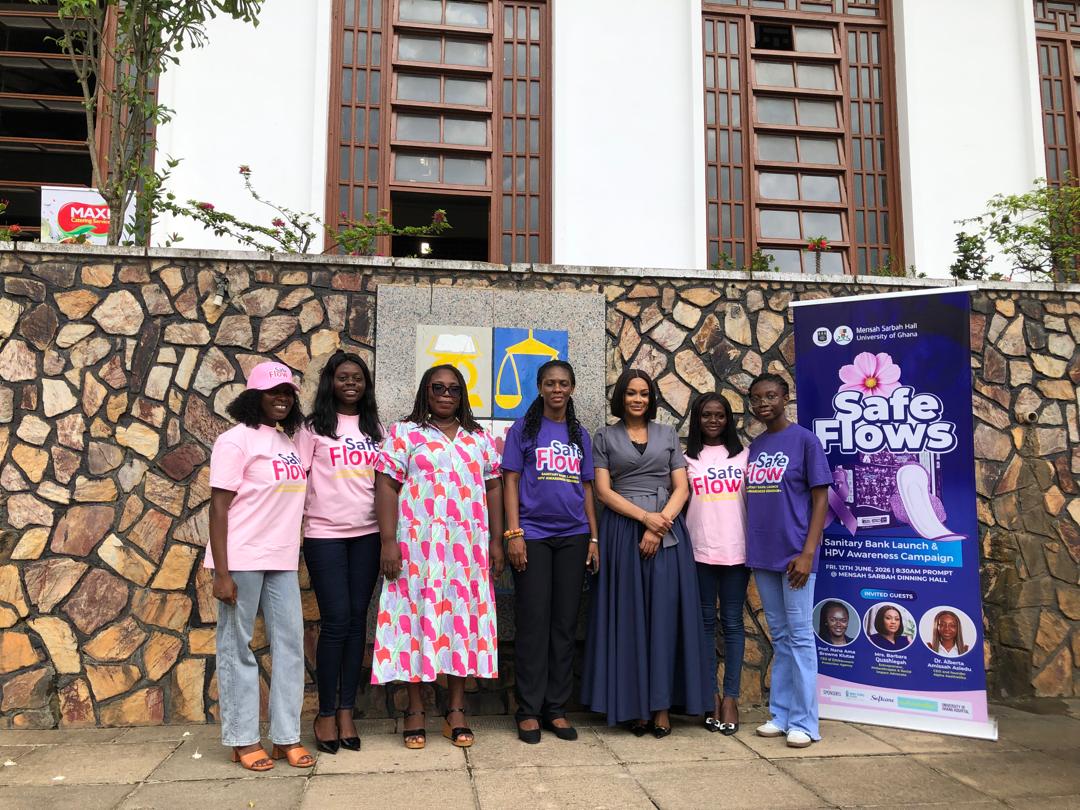

A collective agenda to champion dignity and establish awareness around optimal health for every woman became a reality as the Junior Common Room (JCR) of the University of Ghana’s Mensah Sarbah Hall officially launched a Sanitary Bank for the benefit of female students in the hall.
The initiative, dubbed Safe Flow, was launched at the Mensah Sarbah Dining Hall and brought together students from across the university for insightful discussions on menstrual hygiene, reproductive health, HPV awareness and the importance of ensuring access to sanitary products for young women on campus.

The Sanitary Bank seeks to address period poverty by providing free and accessible sanitary products to students who may struggle to afford them, while also creating a supportive environment that promotes menstrual health and dignity.
Entrepreneur, philanthropist and social media impact advocate, Barbara Quashigah, who serves as a donor and legacy partner of the initiative, commended the leadership of the hall for championing a cause that directly impacts the welfare and confidence of young women.
She emphasized the need for collective action in ensuring that no female student is disadvantaged academically or socially because of limited access to menstrual hygiene products, noting that menstrual health remains an essential component of overall well-being.
Senior Lecturer at Department of Linguistics and Former Deputy Senior Tutor at Mensah Sarbah Hall, Dr. Yvonne Agbetsoamedo in an interview with YFM described the event as an eye opener which duly satisfied the curiosity of all young women present. “The resource persons were on top of their game, they were brilliant and the students were also very interactive, they asked so many questions; when you hold a program and nobody asks questions and nobody talks then you can’t call that a successful program but there were more questions even than time permitted.”
Beyond providing sanitary products, the Safe Flow initiative also focused on raising awareness about Human Papillomavirus (HPV) and cervical health through educational engagements with health professionals. Organizers noted that the programme was intentionally designed to be inclusive, encouraging both male and female students to participate in conversations surrounding menstrual and reproductive health.
The launch featured educational discussions, health awareness sessions and giveaways, all aimed at fostering a well-informed campus community while advancing the fight against period poverty.
With the establishment of the Sanitary Bank, Mensah Sarbah Hall hopes to set a precedent for similar interventions across tertiary institutions, ensuring that access to menstrual hygiene products becomes a right rather than a privilege for young women.