
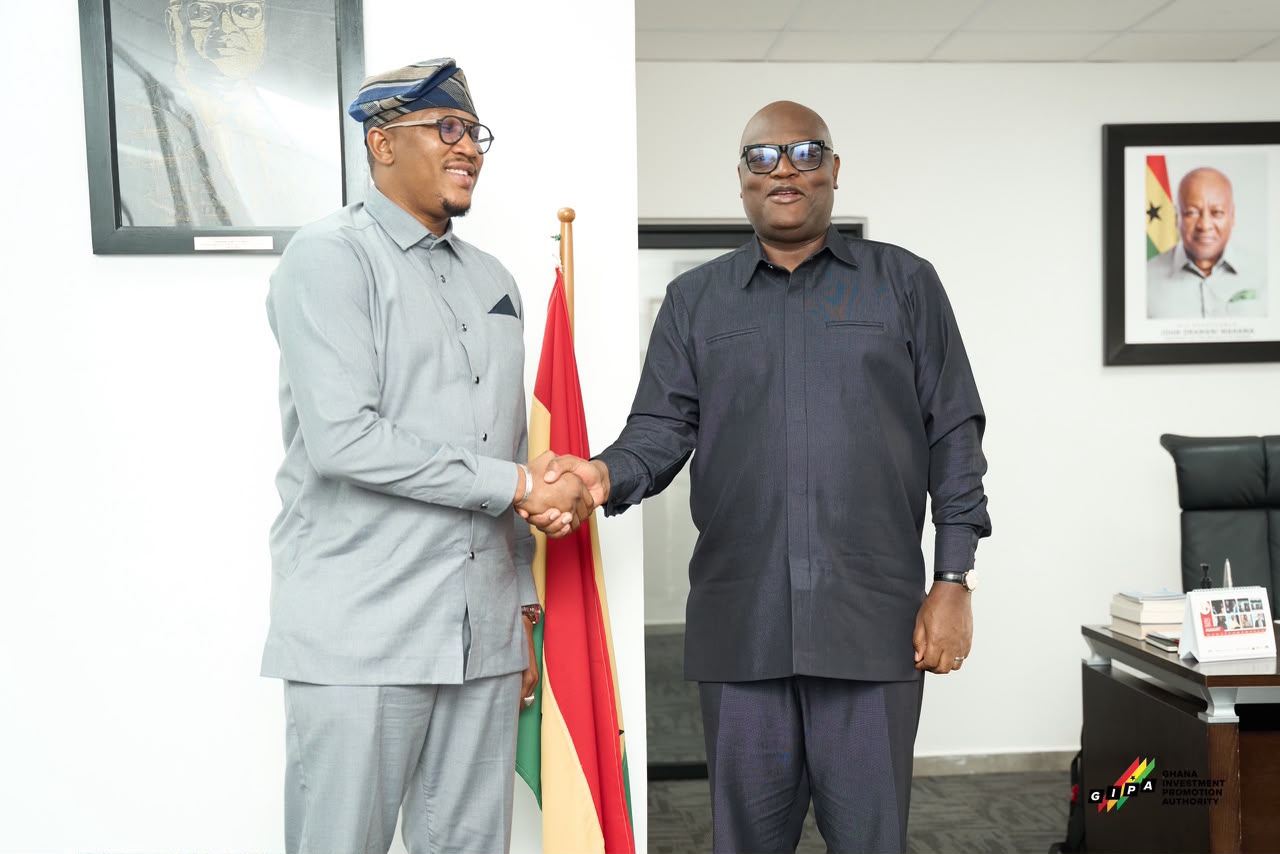

Ghana’s High Commissioner to Nigeria, H.E. Baba Sadiq Abdulai Abu has pledged to intensify efforts to attract more Nigerian investment into Ghana and expand commercial opportunities for Ghanaian businesses in Nigeria under a new “Ghana in Nigeria” economic diplomacy agenda.
The High Commissioner made the commitment following a courtesy meeting with the Chief Executive Officer of the Ghana Investment Promotion Centre (GIPC), Simon Madjie, in Accra ahead of his departure to Abuja.
The meeting focused on strengthening Ghana-Nigeria economic and commercial relations, with particular attention to investment promotion, bilateral trade, and creating opportunities for businesses and investors in both countries.
The renewed push comes against the backdrop of Nigeria’s growing contribution to Ghana’s investment landscape.
According to Ghana’s 2025 investment data, Nigeria was the third-largest source of foreign direct investment by value, contributing US$104.68 million to Ghana’s investment inflows. The figure formed part of more than US$2.6 billion in foreign investment recorded across 254 projects during the year.
Nigeria also accounted for 10 registered investment projects during the year, placing it among the leading sources of foreign investment activity in Ghana, although China led by project count with 70 projects.
The figures underscore the depth of existing commercial links between the two West African economies while also highlighting significant room for further growth.
For Baba Sadiq, the current level of Nigerian investment represents an opportunity to move Ghana-Nigeria relations beyond their traditional political, cultural, and diplomatic foundations towards a stronger economic partnership.
“These numbers point to an even greater opportunity. Strengthening economic diplomacy will be a key priority for Ghana in Nigeria,” he said.
Deepening the investment relationship
Under the proposed “Ghana in Nigeria” agenda, the Ghana High Commission intends to work closely with the GIPC and other relevant stakeholders to promote Ghana as an attractive destination for Nigerian capital while supporting Ghanaian businesses seeking opportunities in Nigeria.
The initiative is expected to focus on connecting businesses, investors, and institutions in both countries, identifying investment opportunities, and strengthening the commercial networks that underpin bilateral trade.
Baba Sadiq believes the Ghana High Commission should play a more active role in facilitating these connections and using diplomacy to deliver tangible economic opportunities for Ghanaian businesses and investors.
The approach is particularly significant given Nigeria’s position as one of Africa’s largest economies and its established corporate presence across sectors such as banking, telecommunications, consumer goods, manufacturing, entertainment, and services.
At the same time, Ghana offers Nigerian businesses access to a stable commercial environment, a strategic location within West Africa and opportunities to leverage the country’s position in the implementation of the African Continental Free Trade Area.
The High Commissioner’s agenda therefore seeks to make the bilateral relationship more mutually beneficial — attracting additional Nigerian capital into Ghana while helping Ghanaian companies identify opportunities to enter, expand and compete in the Nigerian market.
From political ties to economic partnerships
The proposed agenda reflects a broader shift towards using diplomacy as a tool for economic development, trade facilitation, and investment promotion.
Baba Sadiq said Ghana and Nigeria already possess strong historical, political, and cultural ties, but the next phase of the relationship must translate those connections into stronger commercial partnerships.
“Our two countries already share a strong relationship. The opportunity before us is to build an even stronger economic partnership,” he said.
The High Commissioner’s engagement with the GIPC comes as he begins his assignment in Nigeria, where he is expected to make economic diplomacy and the promotion of Ghana’s national interests central to his tenure.
His recent engagements also point to an emphasis on building practical connections between Ghanaian and Nigerian institutions and businesses. In Abuja, he has expressed interest in areas including trade, investment, tourism, and improved connectivity, reinforcing the broader economic focus of the Ghana-Nigeria relationship.
With Nigeria already contributing more than US$100 million in new investment to Ghana in a single year, Baba Sadiq’s challenge will now be to convert that existing commercial relationship into a larger and more diversified investment pipeline.
The “Ghana in Nigeria” agenda could consequently become an important vehicle for strengthening economic diplomacy between the two countries with the ultimate objective of turning longstanding Ghana-Nigeria relations into deeper investment, greater trade and shared economic growth.