
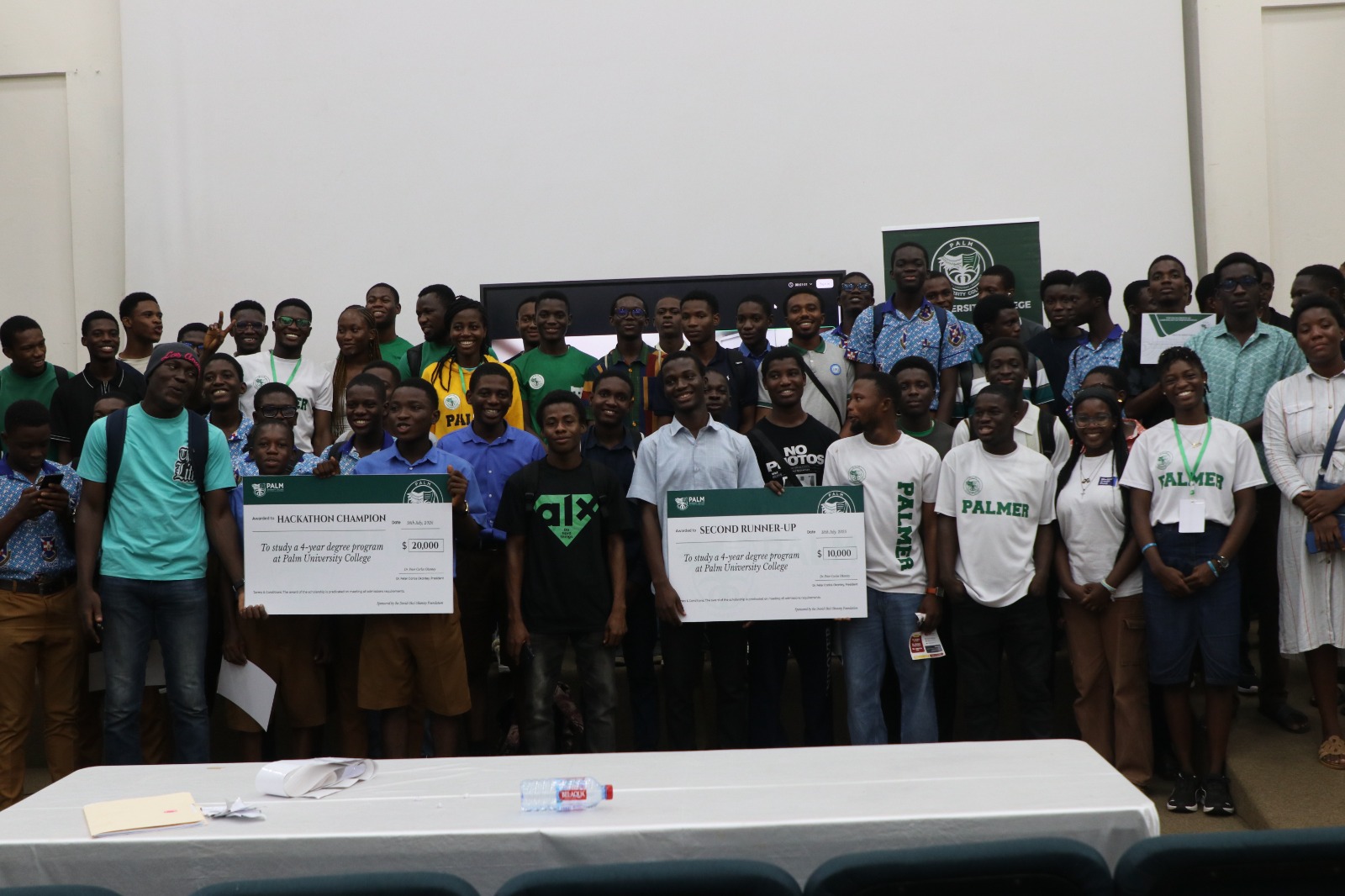

Palm University College has successfully hosted its GreenLab Annual SHS Students and Graduates Hackathon 2026, bringing together some of Ghana’s brightest young minds to develop technology-driven solutions to real-world challenges. The event, held at the Ghana-India Kofi Annan Centre of Excellence in ICT, provided participants with a platform to showcase creativity, critical thinking, and innovation while addressing pressing societal issues.
The hackathon opened with remarks from President of Palm University College, Dr. Peter Carlos Okantey, who encouraged participants to embrace challenges, remain authentic, and see innovation as an opportunity to create meaningful change. He described the GreenLab Annual Hackathon as a platform where ideas are transformed into impactful solutions capable of improving society.
A key highlight of the event was a session led by Eugene Eluerkeh, a Palmer and Growth Catalyst at Growth Africa. He reintroduced participants to the principles and methods of Design Thinking, emphasizing that successful innovators focus first on understanding people and the problems they face before developing technological solutions. Using practical examples from sectors such as healthcare, education, finance, agriculture, and community development, he challenged with an initial exercise where participants were asked to design a wallet based on the concept of design thinking, participants where to focus on creating value rather than just developing solutions.
Throughout the competition, teams worked under pressure to brainstorm ideas, conduct research, design prototypes, and pitch their solutions to a panel of judges. The projects covered a wide range of sectors, including renewable energy, financial technology, healthcare management, waste management, and educational technology, reflecting the students’ desire to leverage technology to solve challenges facing Ghanaian communities.
Beyond the competition itself, the event also sparked discussions around the growing role of Artificial Intelligence in education and innovation. While many participants effectively used AI tools to support brainstorming, coding, and presentations, organisers observed that some projects lacked originality and independent reasoning. The conversation served as a reminder that AI should enhance human creativity rather than replace critical thinking, empathy, and genuine problem-solving.
At the end of the hackathon, all participants received certificates in recognition of their efforts, while top-performing teams were rewarded for their outstanding performances. Team Matrix emerged as the overall winner, followed by Team Nova in second place, with the third-place team also receiving recognition for its innovative solution.